Since the rise of social media, improved mobile cameras, and more accessible transportation, many previously remote places have become reachable for everyone. ‘Off-the-beaten-path’ has become more of a buzzword than a reality.
Discovering hidden gems is slowly becoming a myth. Secret spots only known by locals are just one season and one viral TikTok video or IG Real away from being overrun. The truth is that truly off-the-beaten-path travel destinations exist, and you are just looking for them the wrong way.
In this short guide, I will show you a method that I use when trying to find places that are more intact, less visited, and you can end up having the whole site just for you.
What "Off-the-Beaten-Path" Actually Means Today
Off-the-Beaten-Path travel destinations today are probably not the ones that are far away, but the ones without a bus tour or a TikTok-famous cafe there yet. Many of these destinations usually require an extra effort, a flight, a ferry, or there is even a language barrier, a lack of five-star resorts, or a lack of any accommodation in general. Such off-the-Beaten-Path travel destinations today are places where you are still more of a guest and not just a consumer of a view.
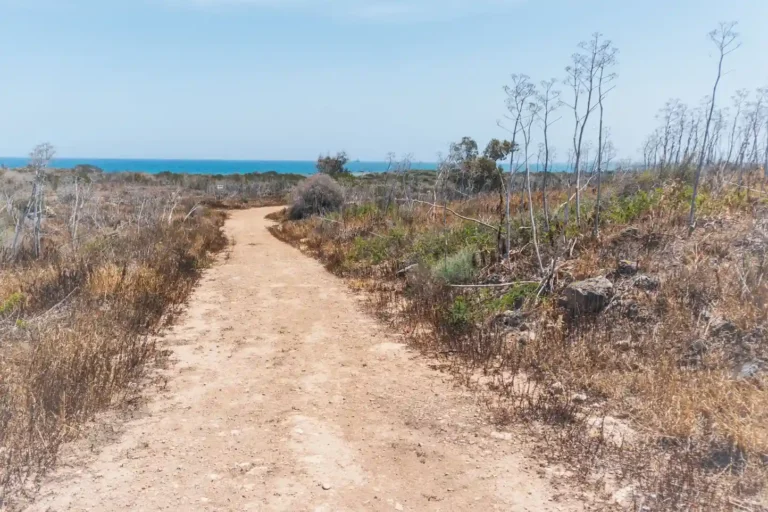
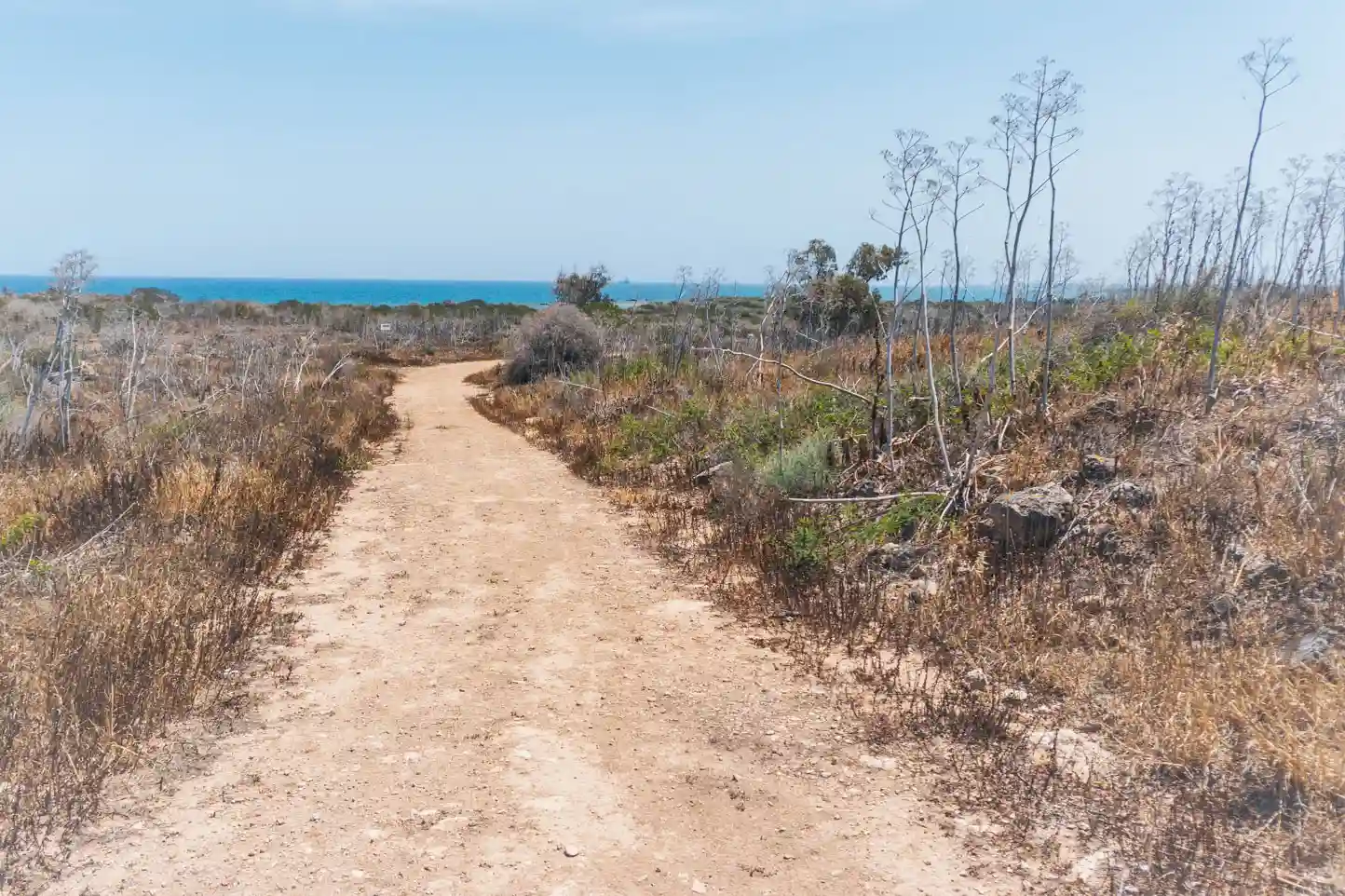
Salamis Plajı surroundings, Cyprus
My SEO Hack for finding hidden places
To find the “un-Googled” spots, you have to trick the search engine into giving you local secrets. Some interesting and non-touristy places might be more discoverable when searching in the local language. Here is what I do to get better results if I am looking for those hidden spots.
Search in Local Language
If you want to find off-the-beaten-path travel destinations, searching in English is often your biggest limitation.
Most English search results are optimized for tourists. That means you’ll keep seeing the same places—“hidden gems” that are no longer hidden.
Instead, try searching in the local language of the country you’re exploring, and you will more likely find or discover
local blogs instead of international travel sites
small forums, regional websites, and lesser-known places
You’ll access content written for locals—not tourists
For example, instead of searching “hidden gems Jordan”, try searching in Arabic (or use translation tools to help you generate the query).
If the language feels like a barrier, you can use tools like ChatGPT or Google Translate to:
translate search queries
understand local websites
even navigate public transport systems (I personally used this method for Jordan, where most transport info was only available in Arabic)
Also, don’t stop at the first page of Google and scroll through multiple result pages,
Check some local forums (country-specific Reddit communities work well) and try to explore smaller, less polished websites.
Use SEO tools
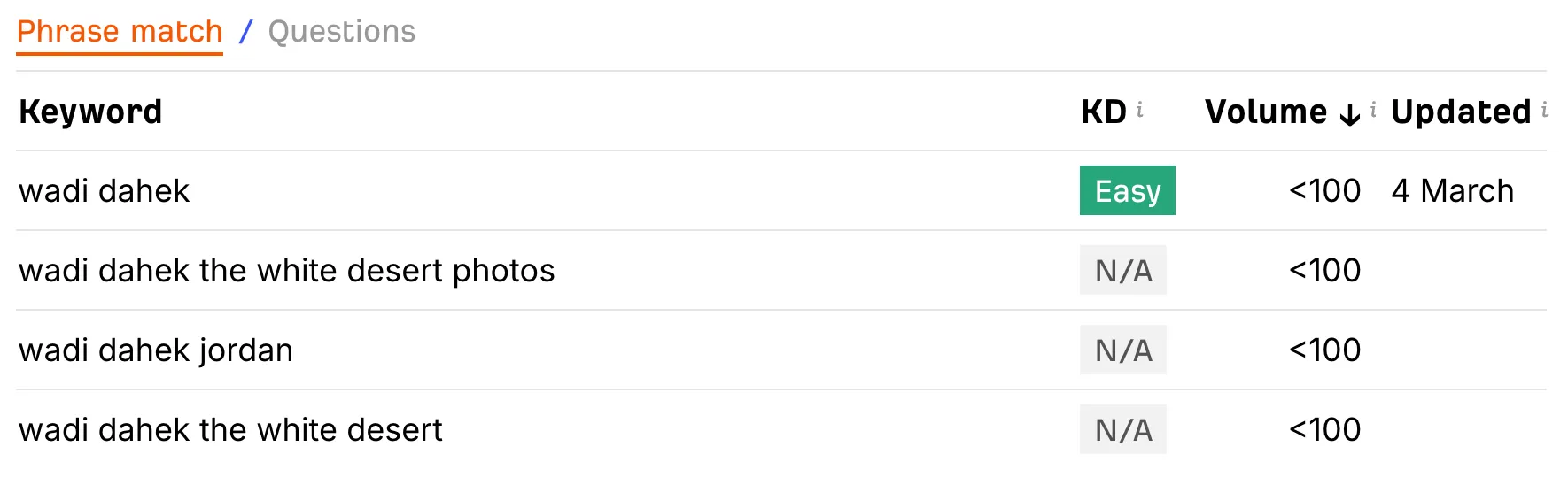
You can also use SEO tools like Ahrefs to search for certain local places. Some of them might be available in English too. The ones that have search volume below 100 and KD (keyword difficulty) not available – that usually means the place potentially belongs to the off-the-beaten-path travel destinations. Even if you use the English language, you might end up finding places that people don’t look up on Google very often. For example, I tried to search for Austria lake and found a couple of lakes that fewer than 100 people are interested in.
Use Google Maps
Google Maps is the most powerful scouting tool if you know how to look past the stars. Zoom into a region you like and look for green areas or coastal outlines without many “camera” icons or pins. Look for places with high ratings but very few photos. If a place has 4.8 stars but only 12 reviews (all in the local language), you’ve found a winner. Use the satellite layer to find physical “paths” or clearings that don’t have an official name yet.
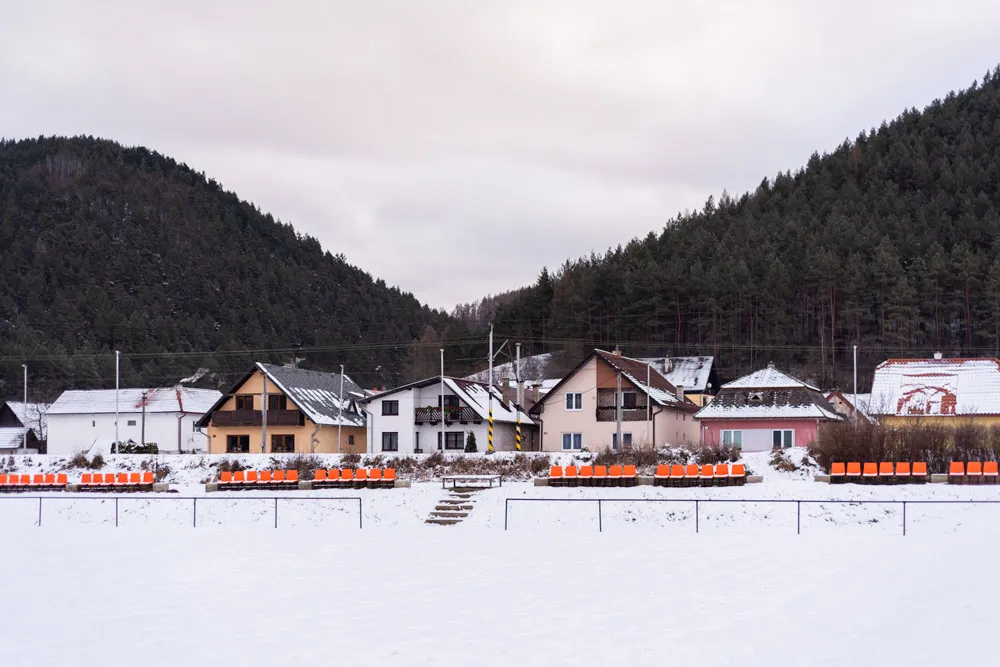
Matejovce nad Hornádom, Slovakia
Reverse-Engineering Popular Routes
Look at a famous destination’s bus or train line. Where does the transport go after the famous stop? Most tourists get off at the “must-see” and never see the next town. The next town might have the same landscape but zero crowds.
Also, when searching for a destination, look up the famous spot, but then scroll to the bottom of the Google search. There might be suggestions that can help you find neighboring regions that might be slightly less optimized for SEO.
Search for a famous influencer’s location tag, then look at the geotags of people who live in that area. Locals usually post from the quiet spots nearby, not the main viewpoint.
Some examples of hidden destinations I found
I used Ahrefs with the search location set to Jordan.
Location: Wadi Dahek, Jordan
Discovery Method: Google Maps
Crowd Level: 0/10
I haven’t visited this place yet. It is not easily accessible by public transport, and even if you plan to visit by car, it seems to require careful preparation. The terrain appears remote and rugged, so a 4×4 vehicle, offline maps, and enough water and supplies would likely be essential. That said, its isolation is exactly what makes it so appealing—untouched landscapes, no crowds, and a sense of true exploration that’s becoming increasingly rare.
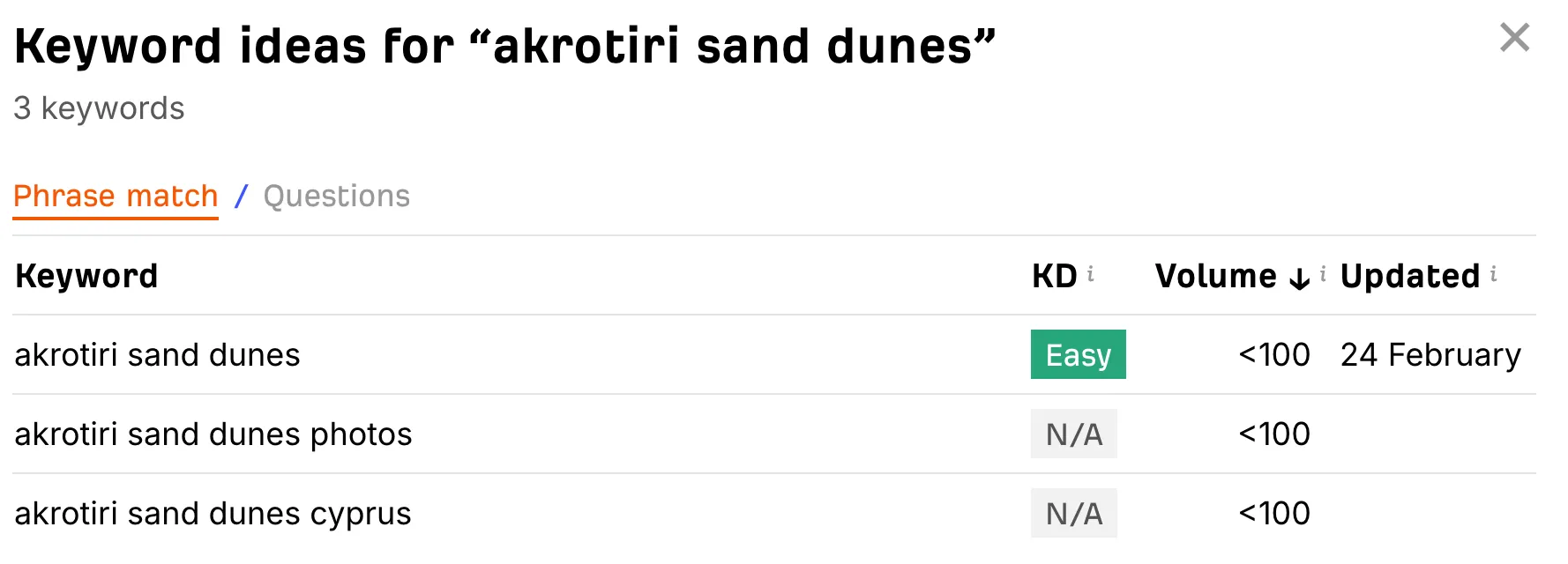
I used Ahrefs with the search location set to Cyprus.
Location: Akrotiri sand dunes, Cyprus
Discovery Method: Google Maps, Google search for desert in Europe
Crowd Level: 0/10
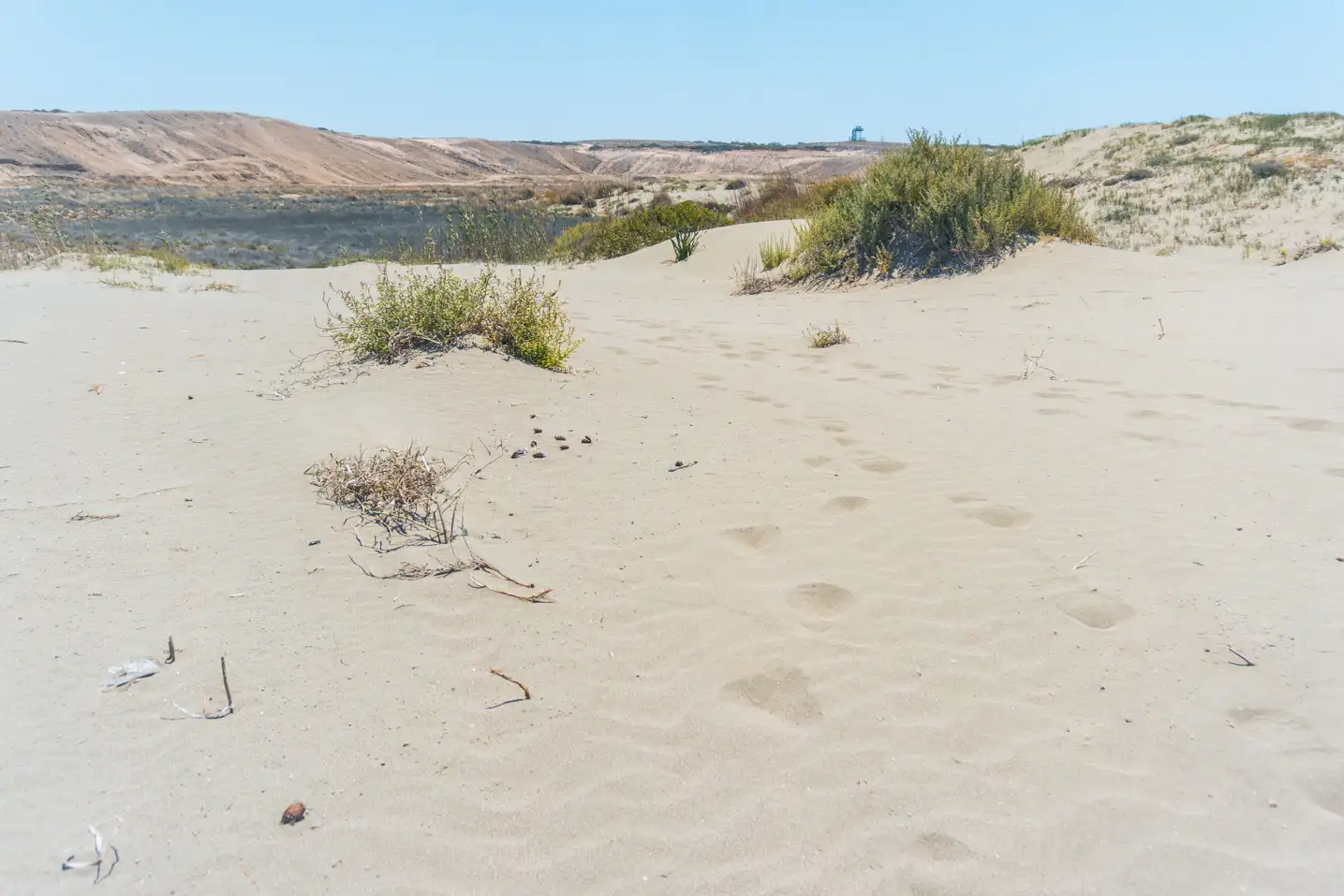
I was already aware of Akrotiri as a British Overseas Territory, which made it interesting in its own right. However, during my first visit to Cyprus, I prioritized more well-known spots like Kourion. When I returned to the island, I realized that Akrotiri was the kind of place that truly deserves exploration—less obvious, more raw, and far from the typical tourist trail.
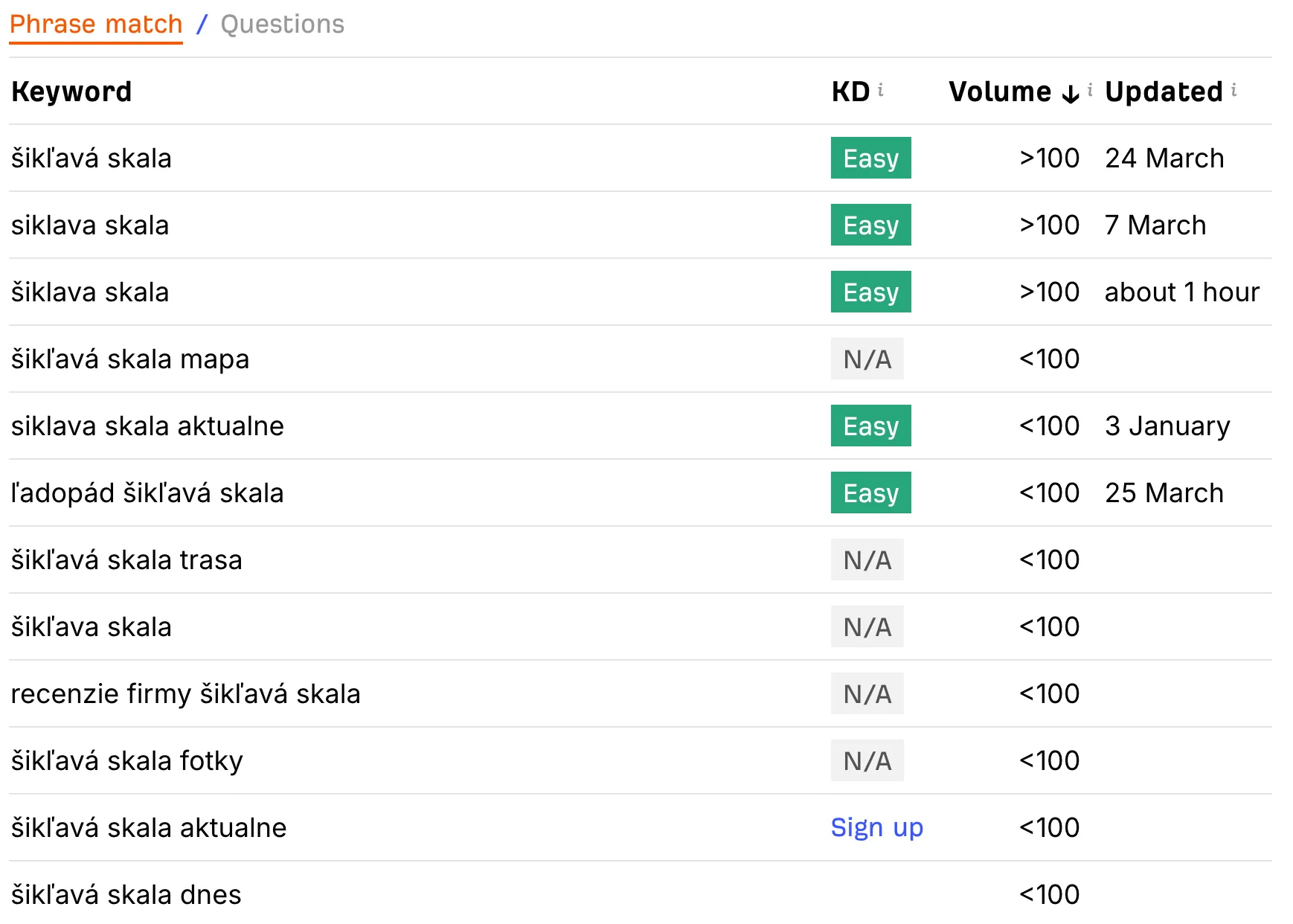
I used Ahrefs with the search location set to Slovakia.
Location: Šikľavá skala, Slovakia
Discovery Method: Google search in Slovak for some interesting photography backdrop places
Crowd Level: 0/10
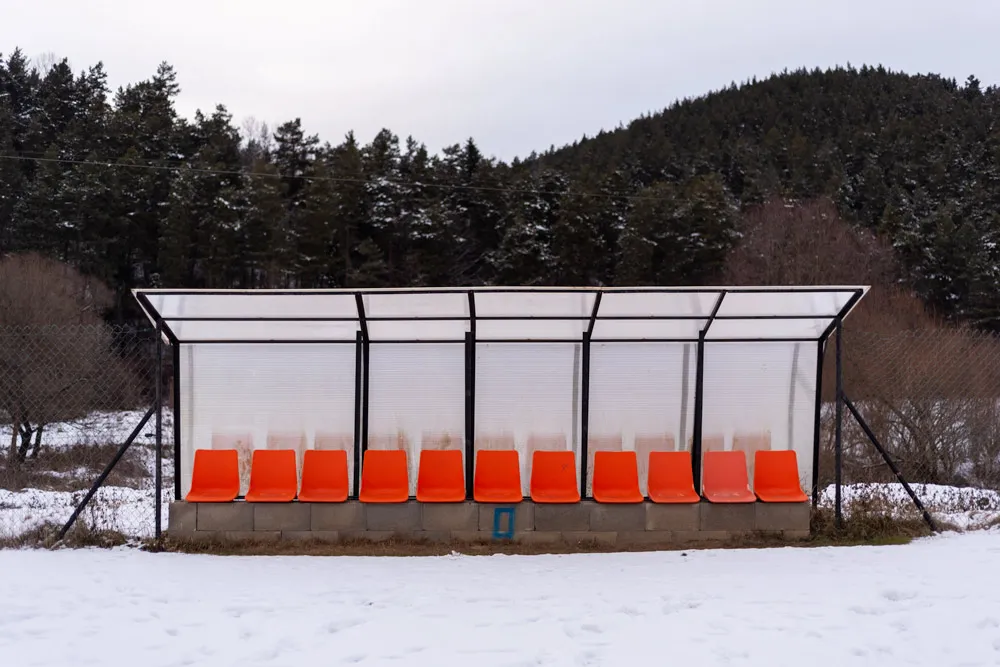
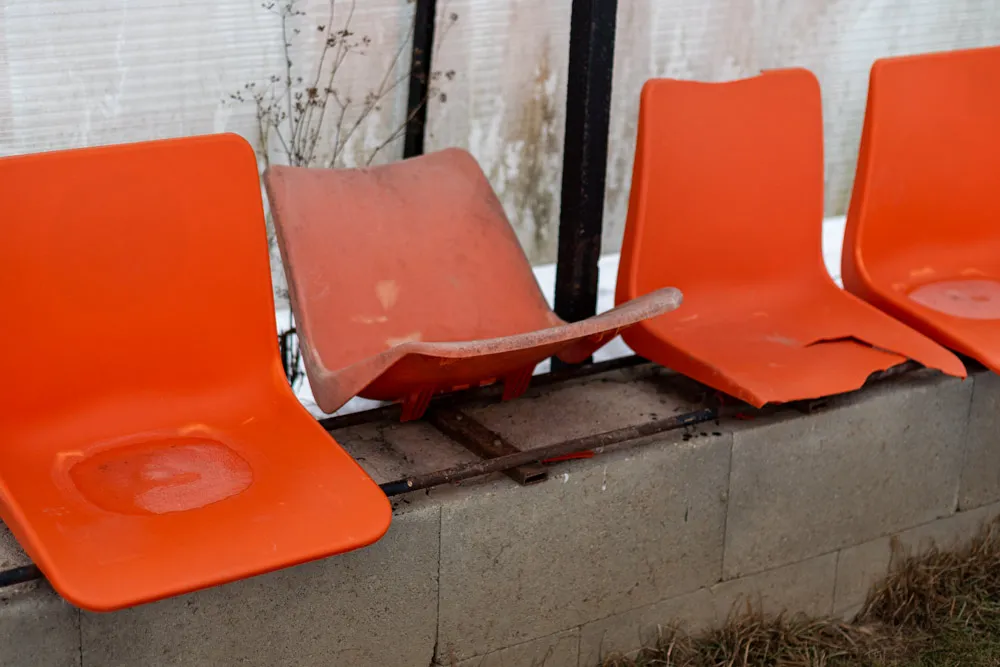
This is one of those places that suddenly gained attention on Instagram during the winter of 2025–2026. People are now even searching for “things to do in Matejovce nad Hornádom,” which is quite amusing. In reality, it’s just a small village—like many others in Eastern Slovakia—with a church, a primary school, a local pub, a football pitch, a railway line, and forests all around. The contrast between its online popularity and its everyday simplicity is part of what makes it so interesting.
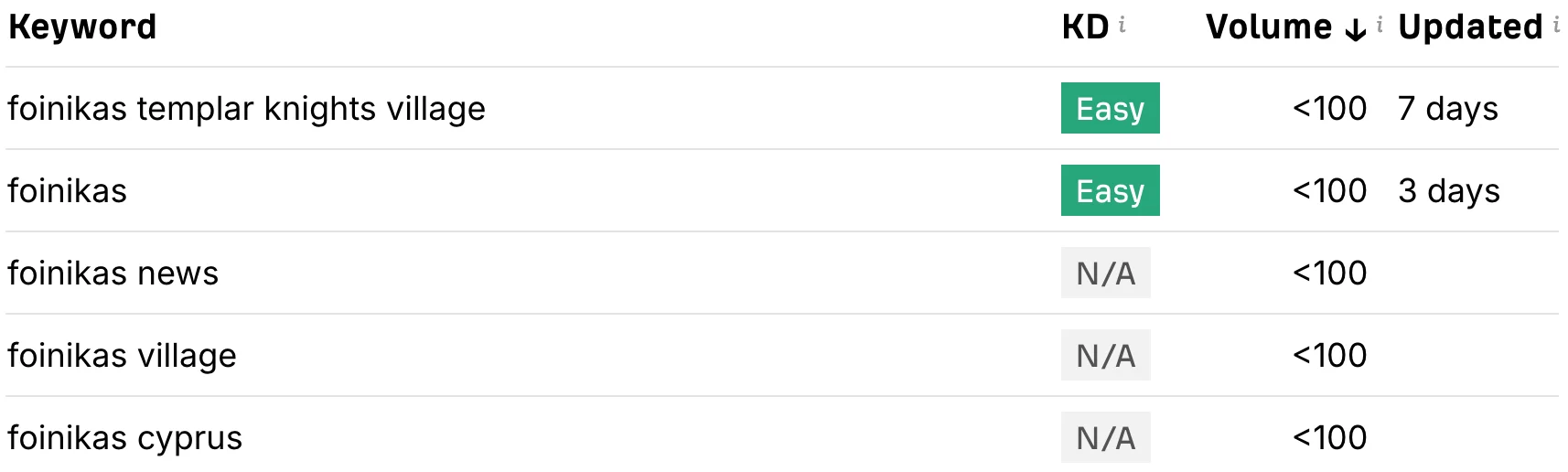
Ahrefs for Cyprus country and keyword Foinikas.
Location: Foinikas, Cyprus
Discovery Method: Google search for abandoned villages in Cyprus
Crowd Level: 0/10
This village—along with many other abandoned ones on the island—remains largely out of sight for most visitors. While the majority of travelers head to well-known ancient ruins and archaeological sites, places like Foinikas offer a very different kind of experience. They are often remote, quiet, and somewhat forgotten. Reaching them can be challenging, and in some cases even risky without proper preparation, especially by car. But that sense of isolation is exactly what gives these places their unique atmosphere.
Mistakes People Make When Searching Hidden Gems
To summarize some common mistakes or approaches that I have already touched on in previous paragraphs:
Confusing “Remote” with “Hidden.”
Following Instagram, TikTok, Instead of Exploring
Ignoring Google Maps as a Discovery Tool
Searching Only in English
Trusting “Hidden Gems” Lists Too Much
Akrotiri sand dunes
Why Hidden Gems Are Hard to Find Today
Words like off-the-beaten-path or hidden gems have slowly become more marketing labels than a geographical reality. Thanks to social media, we now have echo chambers, and every hidden destination can sooner or later become the next best stop for someone’s Instagram photoshoot event.
Thanks to the growth of AI tools and the copy-paste culture, many travel websites don’t actually travel anymore. They just rewrite existing lists. If 50 blogs say “Isle of Skye is a hidden gem,” Google thinks it’s the ultimate truth, even if the parking lots are overflowing.
Algorithm trap
This is more of a technical problem. Google rewards posts that already have clicks. Those no longer hidden gems will stay at the top of search results for years. And definitely, this position will not make them very hidden or undiscovered.
Social Media Effect
Another issue is that social media algorithms tend to favor high-contrast, highly stylized locations. If a place doesn’t fit a very specific idea of what’s “Instagrammable,” it often gets pushed into obscurity. As a result, some destinations—especially cities—begin to reshape themselves to match these visual trends, risking a kind of “Disneyfication” in the process. (For more on this, see this video: [https://www.youtube.com/watch?v=AvkBR3_wjiE]
I bet that the majority of people saw beautiful videos from the Dead Sea in Israel and Jordan, but not many saw the interesting industrial construction sites along the way (from the Israeli side), which can be more attractive to a specific group of people.
Personalized Feeds
Besides the algorithm traps, there are also personalized bubbles. Once you click on one photo of Bali or a club in Berlin, and suddenly your feed offers you to see 1000 more videos that focus on that place. You stop seeing the rest of the world because the AI thinks you only want what’s popular.
What “Off-the-Beaten-Path” Actually Means Today
Off-the-Beaten-Path travel destinations today are probably not the ones that are far away, but the ones without a bus tour or a TikTok-famous cafe there yet. Many of these destinations usually require an extra effort, a flight, a ferry, or there is even a language barrier, a lack of five-star resorts, or a lack of any accommodation in general. Such off-the-Beaten-Path travel destinations today are places where you are still more of a guest and not just a consumer of a view.
Matejovce nad Hornádom
Matejovce nad Hornádom
Matejovce nad Hornádom
The Ethics of visiting off-the-beaten-paths
Finding (and even visiting) a secret spot is a privilege, not a right. When you use these SEO hacks to bypass the “tourist bubbles,” you are entering fragile ecosystems and local communities that aren’t always prepared for visitors.
Respect should come first. That means leaving no trace, avoiding geotagging sensitive locations, and not sharing exact directions to places that could be easily overwhelmed. It also means understanding that not every place is meant to be “content.” Some locations exist outside of the algorithm—and should stay that way.
At the same time, being mindful of local communities is just as important. If you do pass through a small village or remote area, support it respectfully: buy something locally, follow local norms, and don’t treat the place as an attraction built for you.
Sources:
ahrefs
Is Prague just a Disneyland for tourists now? (Honest Rant), available online: https://www.youtube.com/watch?v=AvkBR3_wjiE
Edit Template
Sources:
Cookie Consent
We use cookies to optimize your experience, personalize content, and analyze our traffic. By clicking "Accept All", you agree to our use of cookies for a smoother and faster browsing experience. Learn more in our Privacy Policy.
Contains information related to marketing campaigns of the user. These are shared with Google AdWords / Google Ads when the Google Ads and Google Analytics accounts are linked together.
90 days
__utma
ID used to identify users and sessions
2 years after last activity
__utmt
Used to monitor number of Google Analytics server requests
10 minutes
__utmb
Used to distinguish new sessions and visits. This cookie is set when the GA.js javascript library is loaded and there is no existing __utmb cookie. The cookie is updated every time data is sent to the Google Analytics server.
30 minutes after last activity
__utmc
Used only with old Urchin versions of Google Analytics and not with GA.js. Was used to distinguish between new sessions and visits at the end of a session.
End of session (browser)
__utmz
Contains information about the traffic source or campaign that directed user to the website. The cookie is set when the GA.js javascript is loaded and updated when data is sent to the Google Anaytics server
6 months after last activity
__utmv
Contains custom information set by the web developer via the _setCustomVar method in Google Analytics. This cookie is updated every time new data is sent to the Google Analytics server.
2 years after last activity
__utmx
Used to determine whether a user is included in an A / B or Multivariate test.
18 months
_ga
ID used to identify users
2 years
_gali
Used by Google Analytics to determine which links on a page are being clicked
30 seconds
_ga_
ID used to identify users
2 years
_gid
ID used to identify users for 24 hours after last activity
24 hours
_gat
Used to monitor number of Google Analytics server requests when using Google Tag Manager
1 minute
Marketing cookies are used to follow visitors to websites. The intention is to show ads that are relevant and engaging to the individual user.
This script provides interactive maps and affiliate tools for searching and booking accommodations and flights. Cookies are used to correctly display prices, availability, and to anonymously track affiliate booking commissions.