
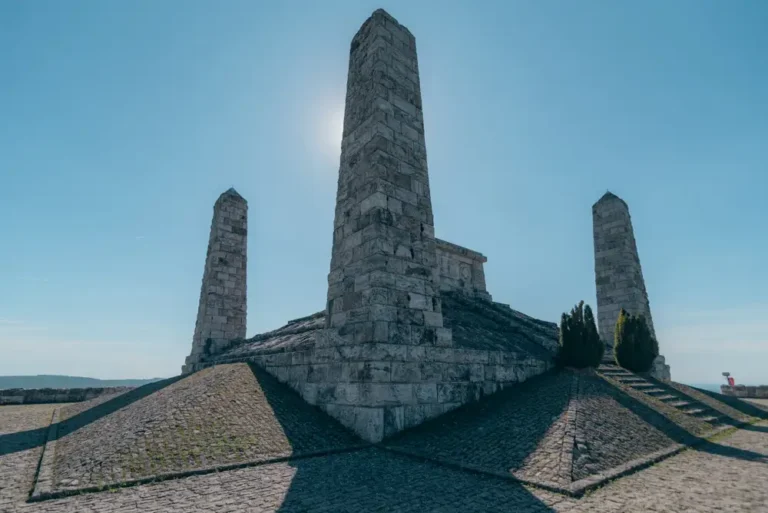
The Barrow of Milan Rastislav Štefánik is a national monument standing on the hill near the small town of Brezová pod Bradlom. In Slovakia, it is known as the Milan Rastislav Štefánik Mohyla. It is a burial place for one of the co-founders of Czechoslovakia. Milan Rastislav Štefánik was a scientist, military leader, and diplomat. The barrow represents a combination of monumental architecture and dramatic natural setting, which both contribute to his ongoing legacy. The next lines will give you a short insight into his life while also covering a day trip to the barrow.

Who Was Milan Rastislav Štefánik?
Milan Rastislav Štefánik is one of the most remarkable figures in the history of Central Europe. Before World War I, he slowly became a scientist and astronomer who gained international attention and respect in regard to his areas of interest. For a certain period of time, he was in the French Army as a general organizing the Czechoslovak Legions.
In 1918, he was one of the instrumental figures forming Czechoslovakia, together with Edvard Beneš and Tomáš Garik Masaryk. Unfortunately, one year later, he died in a plane crash near Ivanka pri Dunaji. Three days later, his family and friends buried him near his birthplace, the village Košariská. The village lies between two towns, one smaller one, Brezová pod Bradlom, and one bigger, Piešťany.


Štefánik Barrow on Bradlo Hill
Štefánik Barrow on Bradlo Hill is a burial site and monument that is supposed to represent the connection of MR Štefánik to the nation and land he helped establish. That is why you won’t see a statue but a stone piece resembling a little bit of Mesoamerican pyramids. It stands above the land as a lasting symbol in national memory, visible from afar.


Architecture of the Barrow of Milan Rastislava Štefánik
The barrow or Milan Rastislav Štefánik Mohyla is a work of the Slovak architect and designer Dušan Jurkovič. People consider him to be the father of modern Slovak architecture. An important figure of the early 20th century. Some of these influences come from the folk sphere. Thus, you can find a combination of folk motifs with modern principles in his buildings.
Milan Rastislav Štefánik Mohyla is mostly made of stone, and it has a fortress-like appearance. When encountering the monument, the first impressions that may come to your mind are strength, permanence, national pride, and maybe a little bit of Yucatán vibes. When you visit the place in the right season, when everything is green around.
The monument has four stone obelisks, one in each corner. People often interpret them as symbols of stability and protection. The terrace has a structure that follows the natural shape of Bradlo Hill. The monument blends with the surrounding landscape in a very seamless and unified manner. When observing the monument from different angles and from a distance, you can see it being harmoniously integrated and connected to its environment.
At first glance, the stepped stone form can remind the observer of ancient pyramids in Mexico. There is no historical connection between the two sites. However, comparing them reveals how different cultures have independently used monumental, elevated architecture to express reverence, memory, and power.
Similarities include the layered platforms – stepped, terraced structure. This rising mass can often communicate the visual language of power, elevation, and permanence. Another similarity is the building materials. Both work with heavy stone. And both put strong emphasis on geometry and symmetry with small to zero decoration. The form speaks for itself; it is the message. Mexican people built the pyramids on ceremonial sites – Milan Rastislav Štefánik Mohyla is also a ceremonial site with its own authority, sacredness, and visibility.


Visiting the Barrow of Milan Rastislav Štefánik Today
Barrow of Milan Rastislav Štefánik is accessible year-round. The best way to reach it is to take a car. There is a direct route that ends at the parking lot, a couple of meters from the monument. But you can also use public transport. Depends on the city you are in – if you are in the capital city, Bratislava, you will need to take a bus or train and change to a different vehicle in another town (usually Piešťany, Nové Mesto nad Váhom, Vrbové, Myjava). When using public transport, you have the opportunity to find a little bit more about the nearby places and compare them.
When arriving at the bus station in Brezová pod Bradlom (right next to a Tesco supermarket and also a small square with public toilets), you can have a look around. If you have enough time, you can also visit the National House of Štefánik or the Museum of Dušan Jurkovič. It is located on the main town square, where you will also find a couple of interesting statues and some fountains.
From the center of the town to the monument on the hill, it is nearly 5 kilometers. If you decide to take this long walk uphill, you will also pass the church of the Holy Trinity and the cemetery, which includes one big memorial stone as well.

Best times to visit and hiking trails
The best times to visit the barrow of Milan Rastislav Štefánik are from spring to autumn when the weather conditions are the best. Especially if you plan to walk and do some hiking.
Several marked hiking trails lead to the Barrow of Milan Rastislav Štefánik on Bradlo Hill:
Red-marked trail (Štefánik Trail / Štefánikova magistrála)
- Difficulty: Moderate
- Duration: 2–3 hours from Brezová pod Bradlom or Myjava
- Notes: Most popular route, well-marked, steady uphill sections, scenic views.
Green-marked trail (route no. 5109)
- Difficulty: Challenging / Long-distance
- Duration: 6–7 hours from Stará Turá (22.6 km)
- Notes: Longer hike, suitable for experienced hikers, mostly forested paths.
Educational nature trail
- Difficulty: Easy to Moderate
- Duration: 2–2.5 hours from Brezová pod Bradlom
- Notes: Features 7 information stops, ideal for families and casual walkers.
Access from nearby villages (Košariská or Priepasné, via Dlhý Vŕšok)
- Difficulty: Moderate
- Duration: 1.5–2 hours, depending on the starting point
- Notes: Shorter, less crowded routes, mostly uphill but manageable, great for locals or day-trippers.
I have used the main road route. It is okay, but quite repetitive, and it offers some areas with shade that are helpful if you are coming on a hot summer day. I tried to take the route that goes via the forest, but I couldn’t find the signs, so I gave up. I was quite happy with it since the route is getting steep and uphill, so it is easier to use the road during a hot and sunny day. There were a few people, some bikers, and a couple of cars passing me by.
The final part of the trail leads to the parking area. There is a restaurant (with a toilet, but it is not public, only available during opening hours), but note that it typically closes around 3–4 PM.

Photography and Atmosphere at Štefánik Barrow
Also, be prepared for strong winds at the monument itself, especially on exposed sections of Bradlo Hill.
For photography, midday sun can be tricky. Harsh sunlight may cast shadows on parts of the monument and make it difficult to shoot against the sky. For the best results, aim for the golden hour—shortly after sunrise or before sunset—or shoot on a cloudy day for softer, more even light.

Why the Barrow of Milan Rastislav Štefánik Still Matters
If you are not from Slovakia, visiting the Barrow of Milan Rastislav Štefánik offers a deeper understanding of one of the nation’s most important figures. The monument continues to inspire, conveying a sense of national pride and collective memory that can leave a lasting impression on visitors. While expressions of national pride may sometimes be understated in everyday Slovak life, this site radiates it in a way that is both monumental and subtle, inviting reflection and recognition.

Sources:
wikipedia
Sources: