
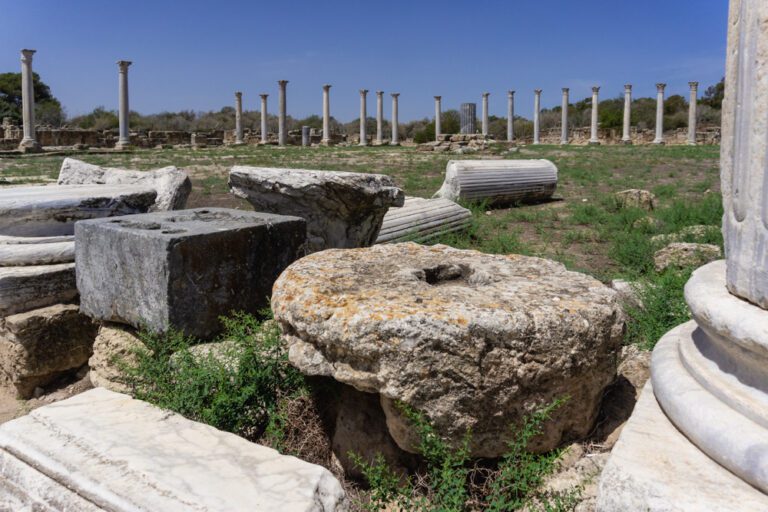
The Salamis Cyprus ruins look like a hidden spot that many people still overlook. It is located in the northern, Turkish-controlled part of Cyprus, near the old town of Famagusta. It remains one of the most important archaeological sites on the island, together with places like Kourion.
It’s not exactly a polished tourist attraction—there are no fancy resorts nearby, beach resorts around it, and getting there already feels a bit off the typical travel routes. My first impression of Salamis was a mix of intense heat, open ruins, and a few sleeping street dogs resting near the old walls. There were still quite a few visitors around (even a family from Slovakia), but most people seemed to spread out or disappear once you moved deeper into the coastal parts of the site.
Where are the Salamis Cyprus ruins
Salamis Cyprus locations is part of the occupied territories that are under Turkish law. The biggest nearby city is Famagusta. Between the main areas lies a long stretch of coastline with a couple of well-known beaches, like Glapsides Beach and Golden Bay Beach. It feels like a transition zone — from quieter, less developed parts of the island to more typical beach areas where people actually stop to swim and relax. There is also a military space, Güven Orduevi, and you will see signs if you enter this area.
Between Famagusta and Salamis ruins runs a highway, Salamis Yolu, and there are road signs indicating where to turn off for the ruins. It is a roundabout, and if you turn left, you will end up in the village Yeni Boğaziçi.
The Salamis Cyprus map can be confusing because there are two nearby locations with similar names. One of them is the main entrance to the Salamis Ruins. It lies right next to Salamis Beach (Salamis Plajı). The other, marked as Salamis Forest (or Salamis Ormanı), lies further north, closer to the area around Venus Hotel. The one near the Salamis beach is the correct location, marked by the official entrance gate with a large “Salamis” sign. Before visiting, I read about a couple who were taken to the wrong address, either by a taxi or a local they had hitched a ride with.
My own experience was quite different: after crossing the Deryneia checkpoint, I hitched a ride with a former archaeology student and his father. They were incredibly kind and insisted on dropping me off right at the entrance to the ruins.
History of Salamis Cyprus
The history of Salamis in Cyprus is closely connected to the Greeks and the legendary figure Teucer. Ancient Salamis Cyprus biggest peak, was during the Roman period. Unfortunately, it was severely destroyed by earthquakes and later abandoned. The most preserved parts are near the entrance. Salamis amphitheatre and the columns of the gymnasium are the most outstanding parts.
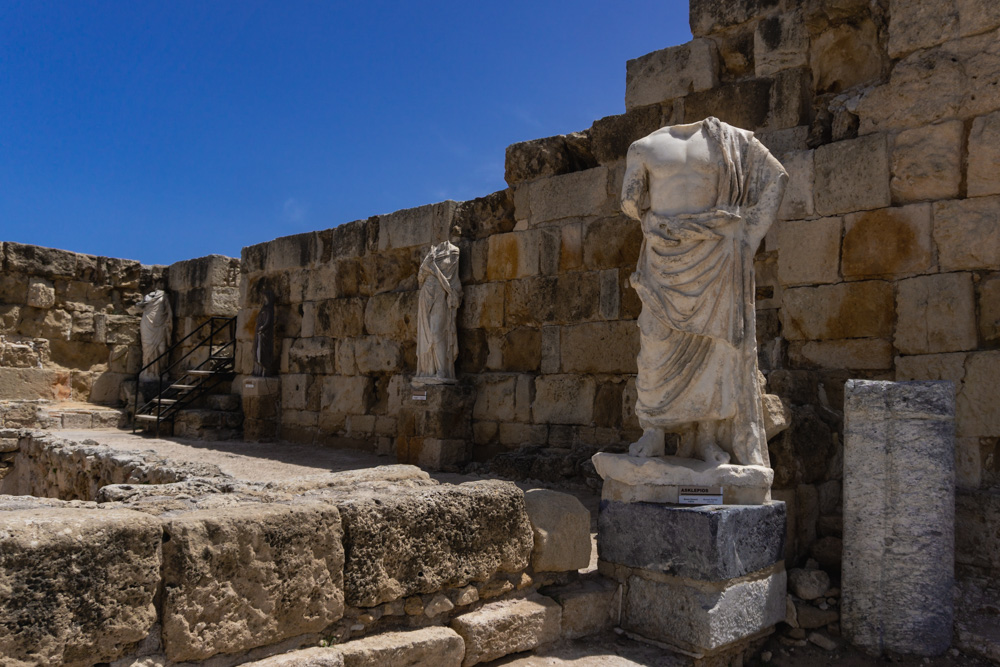
You will find them in many images and documentaries from this area. During my visit, I noticed a documentary crew filming at the top of the amphitheatre. There are some mosaics and statues without heads or with mutilated bodies. Beside the columns lie well-preserved public latrines, which suggest that “going” was a social activity in ancient times. A group of German tourists was there with a guide, all joking about how public the experience would have been.
What to See at the Salamis Archeological Site
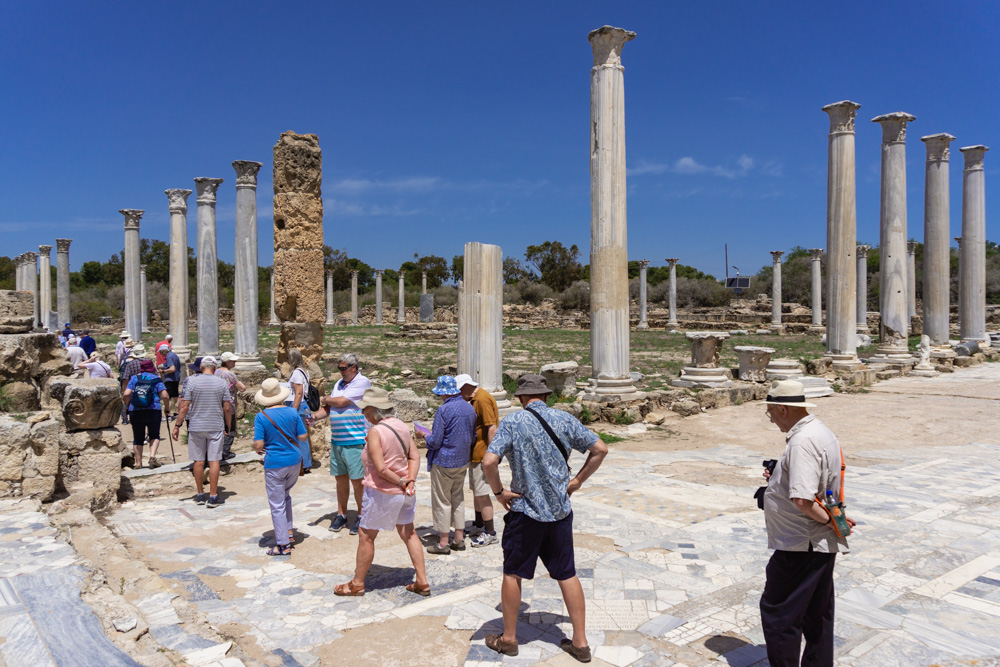
The Salamis Cyprus ruins are often compared to Kourion, though they appear slightly less extensive, at least in my opinion. For me, the most memorable spots and the ones that actually attracted me to this place were the marbles without heads and the columns of the gymnasium. Both of them are the most photogenic parts. But they also attract crowds of visitors today. If you want to take interesting pictures or use the ruins as a backdrop for portraits, it is better to come in the early morning or late afternoon. The heat and sun can be quite challenging during the warmer seasons, which typically begin with spring and end in late autumn.
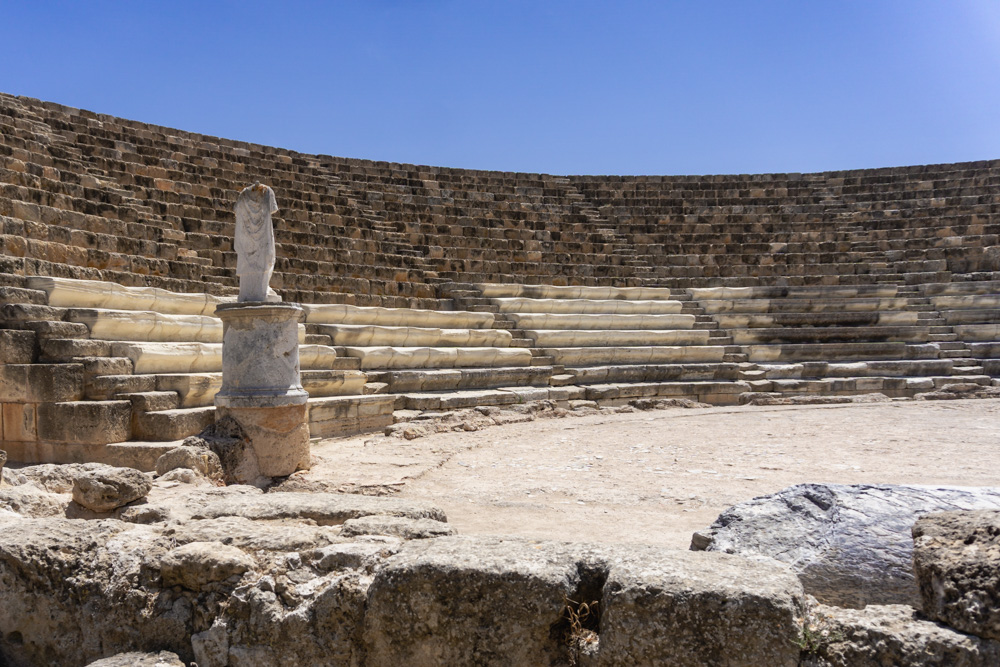
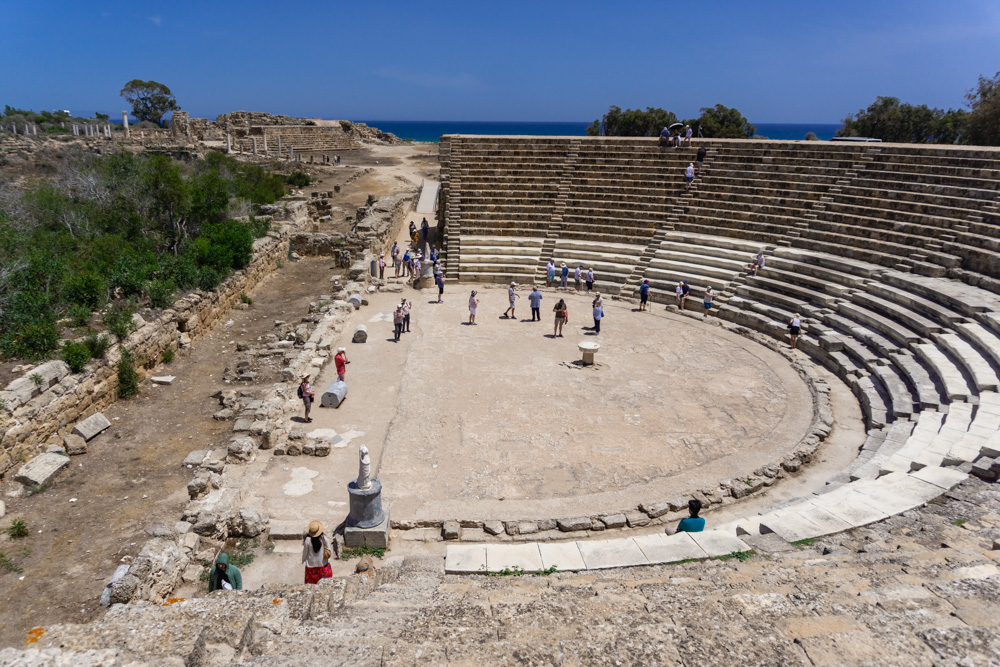
Amphitheatre
The theatre was made for around 15,000 spectators. When entering its area, you will get immersed in its ancient spectacle. The feeling is even better and the situation more exciting when you climb the rocks to the top. The view is great. You can also see the surroundings and better picture the size of the Salamis Cyprus ruins.
You might not be the only person at the theatre, but if you wait a little bit or come at a better time, you will probably have it to yourself. When standing at the top, be careful—there are only a few meters to the edge, and you could easily fall. The two headless statues below add a post-war atmosphere to the scene. Like a fight just ended up there now, not so long ago.
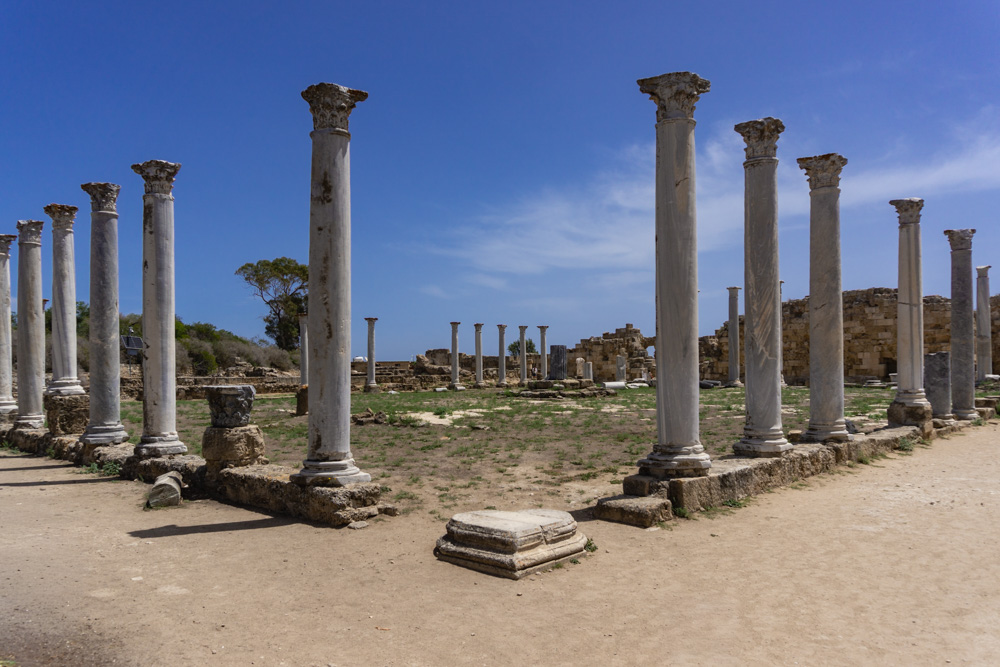
The columns and Gymnasium
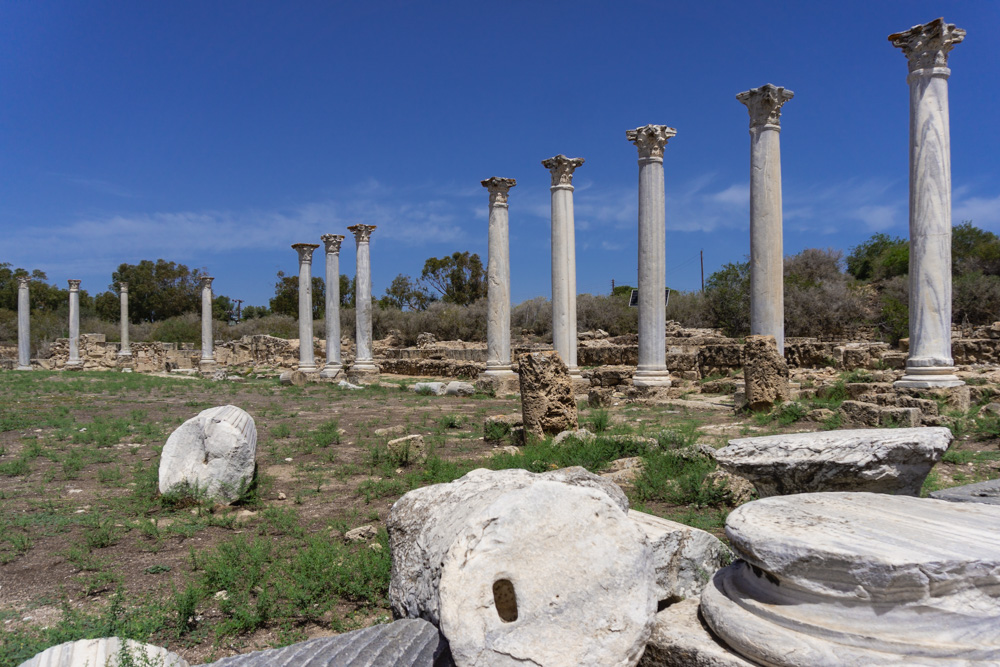
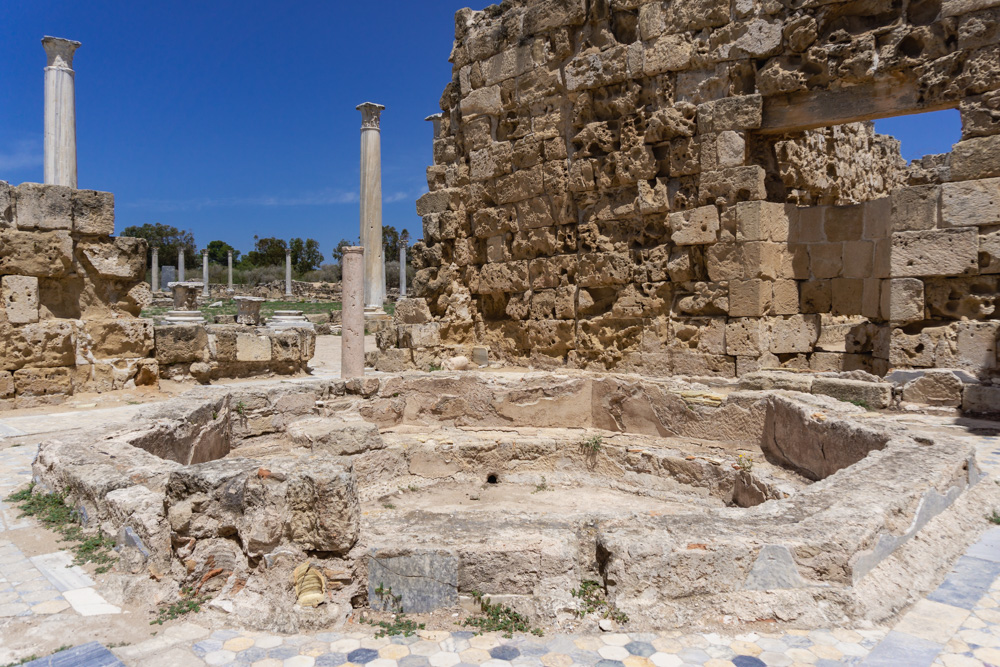
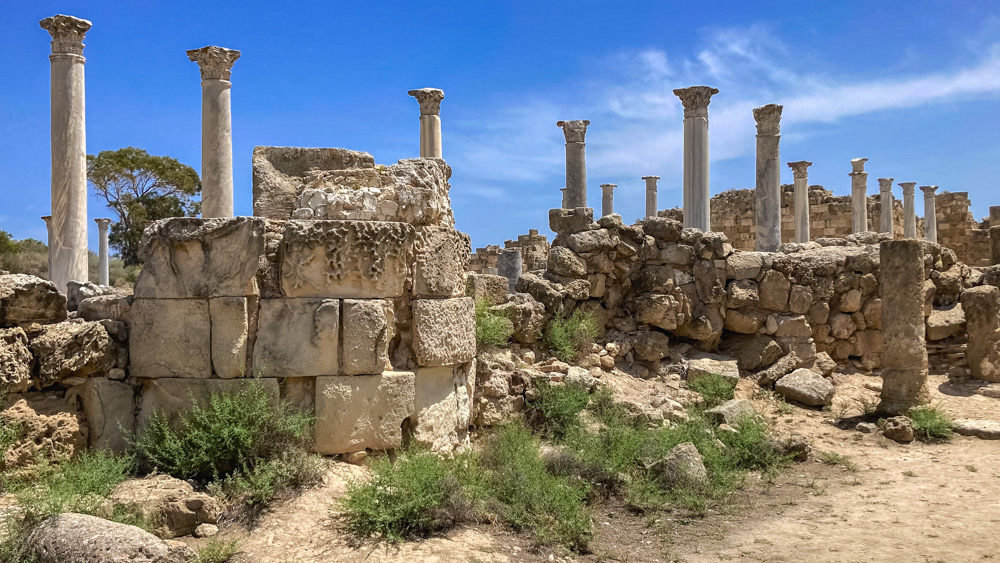
This is probably the most photogenic part of the Salamis Cyprus ruins. The combination of white stone, towering greyish columns, and lush green grass creates an ideal juxtaposition that makes the site feel alive and even a bit playful. During the golden hour, you can capture the sun dipping behind the columns; the long shadows help isolate them as subjects in your photos, making them stand out much more than they would under harsh, midday sunlight.
Kampanopetra Basilica
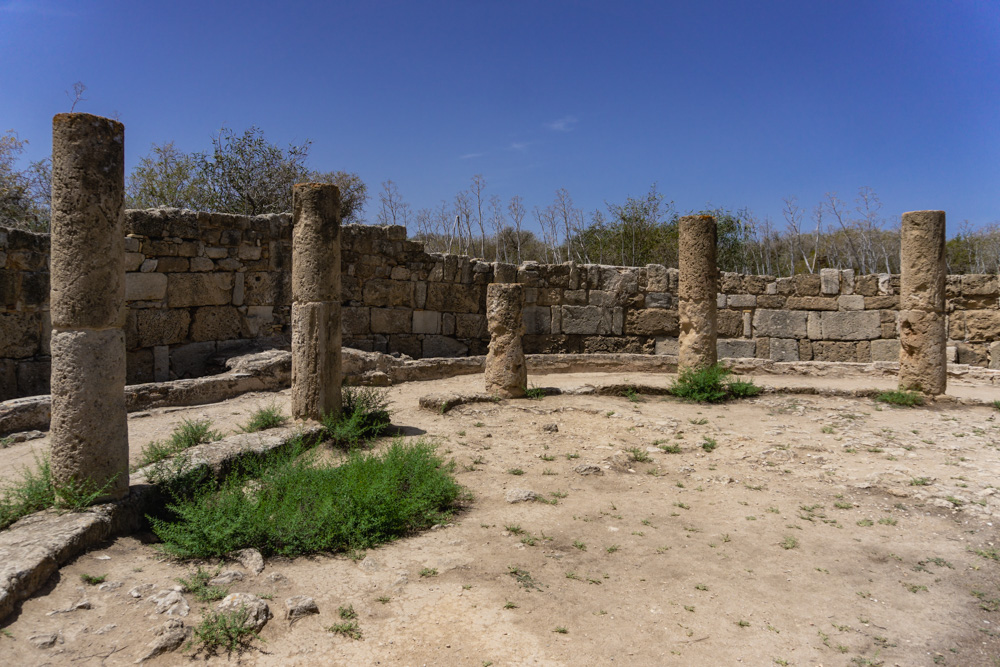
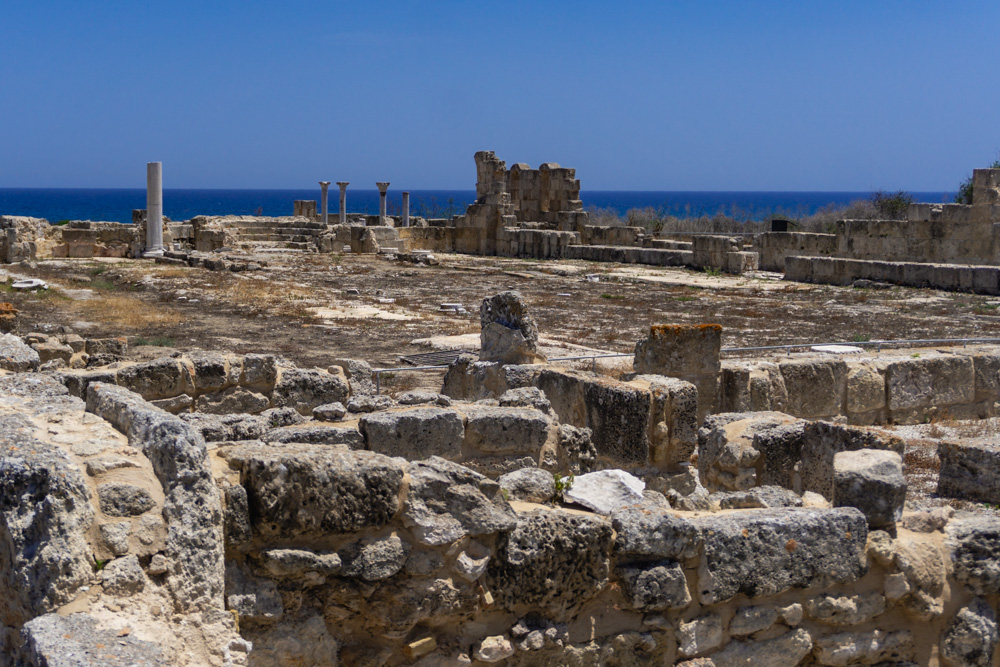
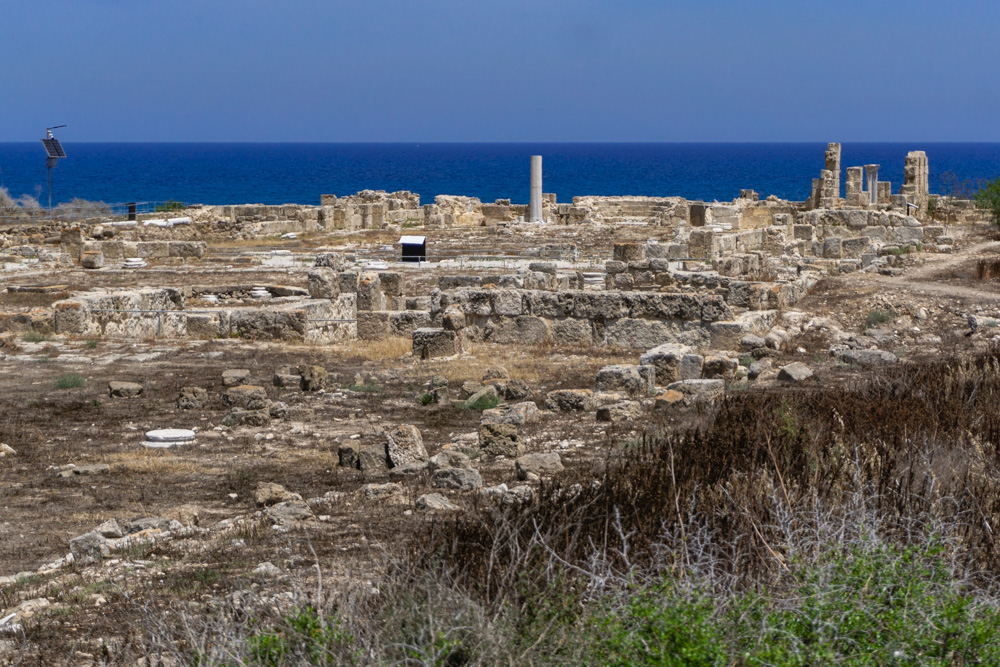
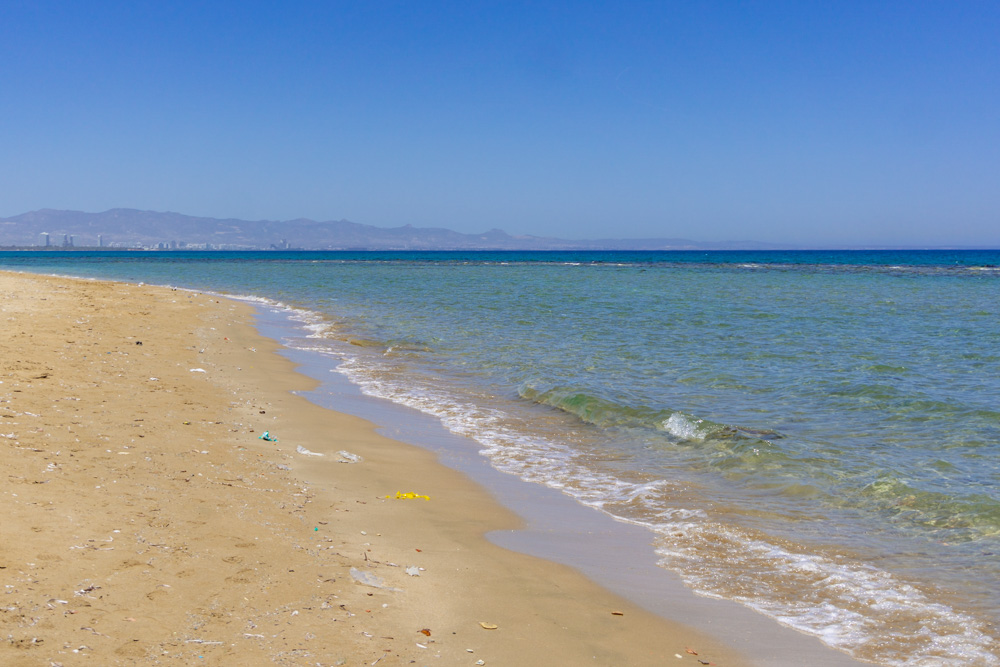
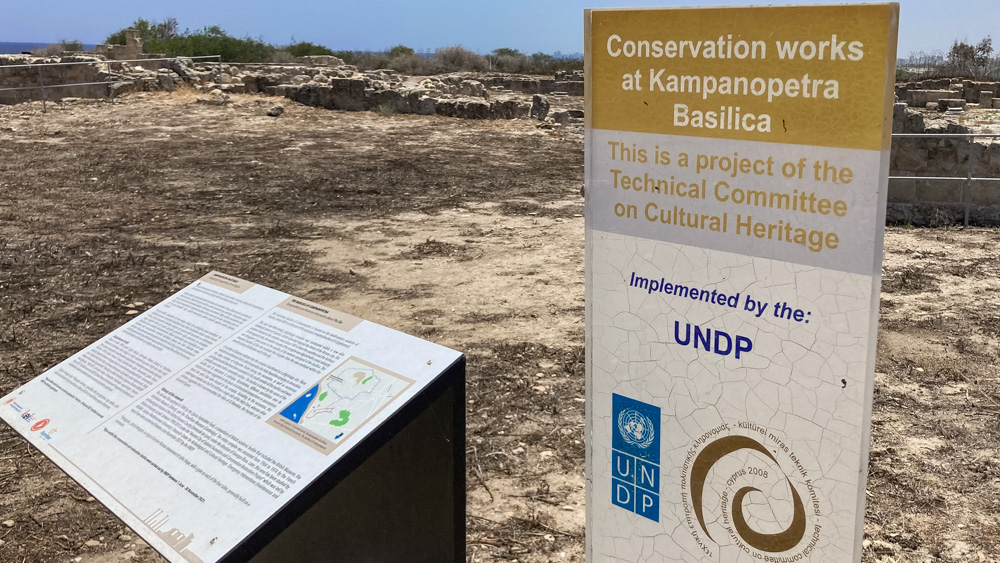
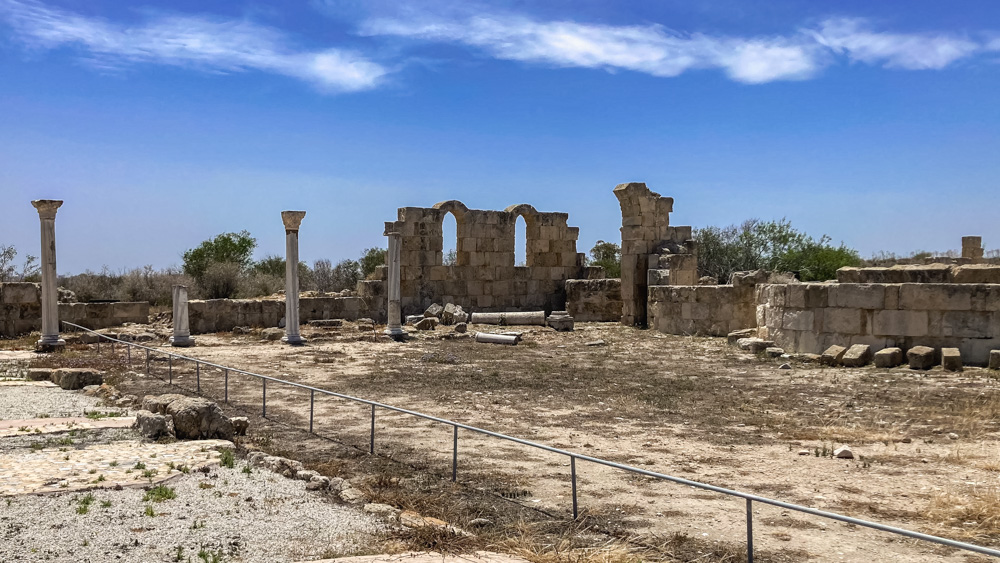
If you have enough time, you can take the longer route and visit the more remote areas of the Salamis Ruins. Some of them are just some stones and a fallen column on the ground. Among them, more outstanding are the ruins of basilicas. One of them is the Kampanopetra Basilica, the other one is the Aziz Epiphanius Basilica. Kampanopetra is the one near the sea. There is a small, narrow road leading to the seashore, which, upon closer inspection, is mostly filled with trash.
Some people (historians and archaeologists) find the most luxurious due to the materials, but also the most mysterious because there is a reason behind it. Why were people so interested in it? It consists of three open-air atriums. One of them used to have a fountain in the middle, while the other used to be the main basilica with two corridors and baths.
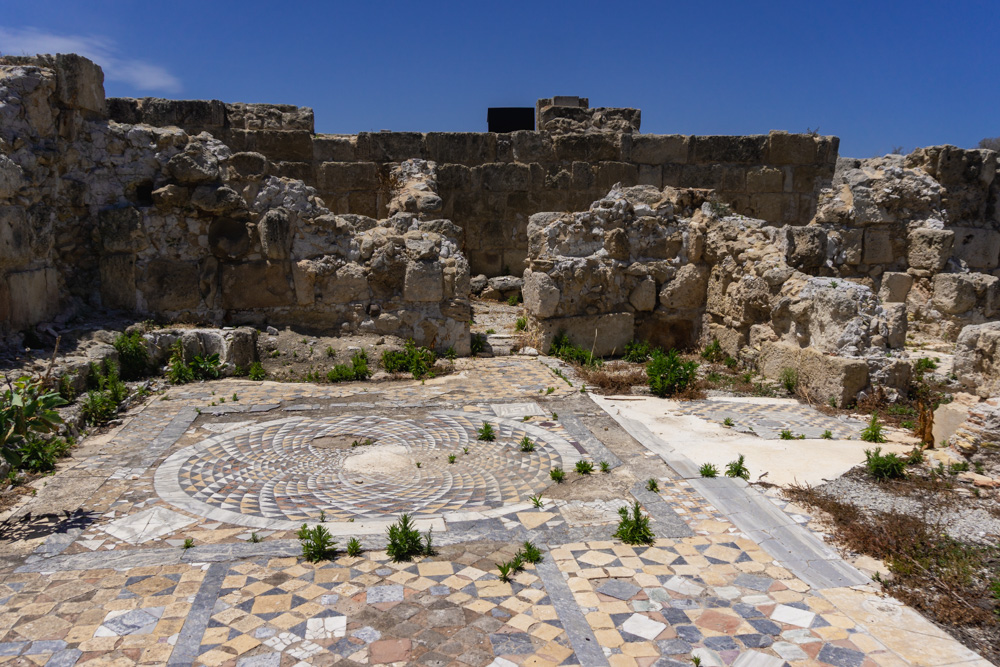
The most remarkable feature is the marble floor. It features rich opus sectile decorations (a mosaic technique using cut stone) in the bath section. The basilica was made of pink marble. One reason why it was used is that it was probably home to a small fragment of the Holy Cross. Today, some people from Cyprus created a hypothetical 3D construction of it.
Next to it, you will find a tall tree with a branch where you can rest for a while under the shade. There are probably just two stops for resting and shade, and this is one of them.
Salamis Cyprus Royal Tombs & Chariot Burials
The Royal Tombs are a bit further west from the main area of Salamis Ruins. You will need to cross the main road to get there. It’s a completely different setting compared to the ruins by the sea. More open, dry, and way less visited. I didn’t actually make it there myself, but it’s still an interesting site if you’re into the deeper history.
The tombs date to the 8th and 7th centuries BC, with some as early as the 11th century. This suggests that Salamis may have coexisted with Enkomi, one of the earliest settlements in the area. Even though they’re called “royal tombs,” there’s no real proof that kings were buried here, based on findings such as pottery, weapons, jewelry, and even horses and chariots buried with the dead.
The whole area is more spread out and less “impressive” at first glance compared to the main ruins, so expectations matter here. It seems like the kind of place where it’s less about big visuals and more about what actually happened there. Also, not everyone ended up buried here. People of lower status were placed in a different necropolis called Cellarka, which is part of the wider area. There’s even a tomb known as the “Prison of Saint Catherine,” which adds a bit of mystery to the whole place.
Visiting Salamis Cyprus (Practical Guide)
The ideal way to visit the ancient Salamis Cyprus ruins is by car. You can rent one, but if you are coming from the non-occupied areas, you will need to purchase new insurance. Alternatively, you can get a taxi ride from Famagusta or try hitchhiking. I did the last one as I was coming from the Derineya checkpoint. I wanted to try public transport. I had read online about special tourist buses, but unfortunately, it didn’t work out. The officers at the checkpoint informed all the waiting tourists that the bus had left the place around 20-30 minutes ago. One of those public buses is supposed to run from the center of Famagusta to Glaphyrides Beach.
I found some evidence on the ground that there is a dedicated bus stop at the beach, and its parking lot is long on my way out of the ruins back to Famagusta. But I did not wait for it, but saw some buses that looked like they could be the ones I’ve found on the site. Generally, I do not recommend relying on public transportation in smaller areas, such as the Salamis Ruins. Public transport here is mostly reliable for bigger towns. It mainly consists of dolmus buses between Nicosia and other larger towns such as Famagusta or Kyrenia.
Opening hours are from 8 AM to 7 PM, and the entrance fee for adults is 50 TL. There are also some free admission days, such as the day I visited the ruins. There is also a public toilet costing around 50 cents to 1 euro ( euros are accepted). It is quite interesting to compare this with the entrance fee.
I have personally paid similar entrance fees at similar archaeological sites in the region. Compared to prices in Slovakia, I think these ruins could charge more, which would help provide additional funds for preservation.
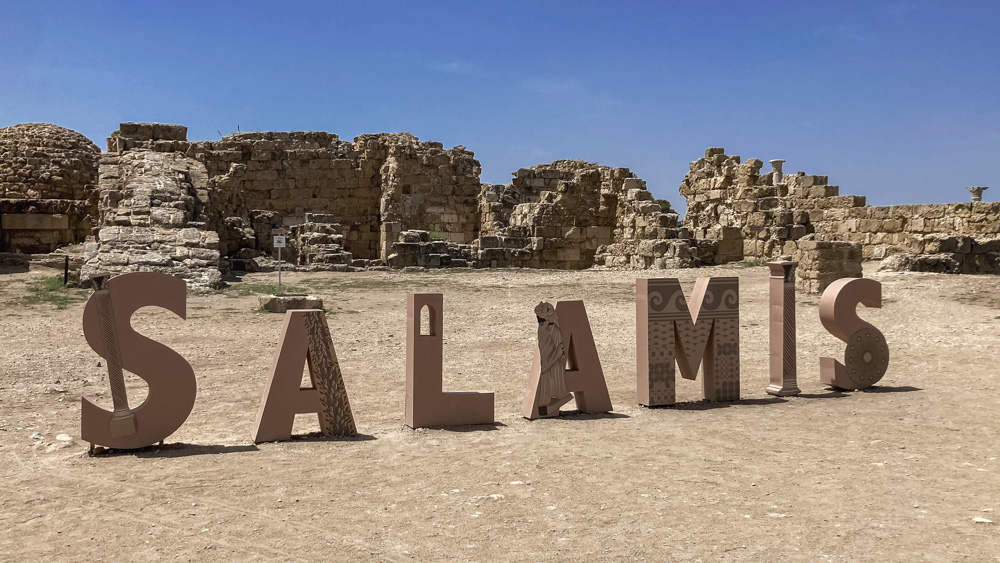
Salamis Beach
One of the highlights is also the beach situated right next to the ruins. It has a very relaxed vibe and seems to be mostly visited by locals. You should not expect any crowds there. Compared to that beach shore you see near the basilica, the beach is quite clean with changing rooms and a bar. The water is quite shallow near the shore, but you’ll need to head further out if you want to dive or snorkel.
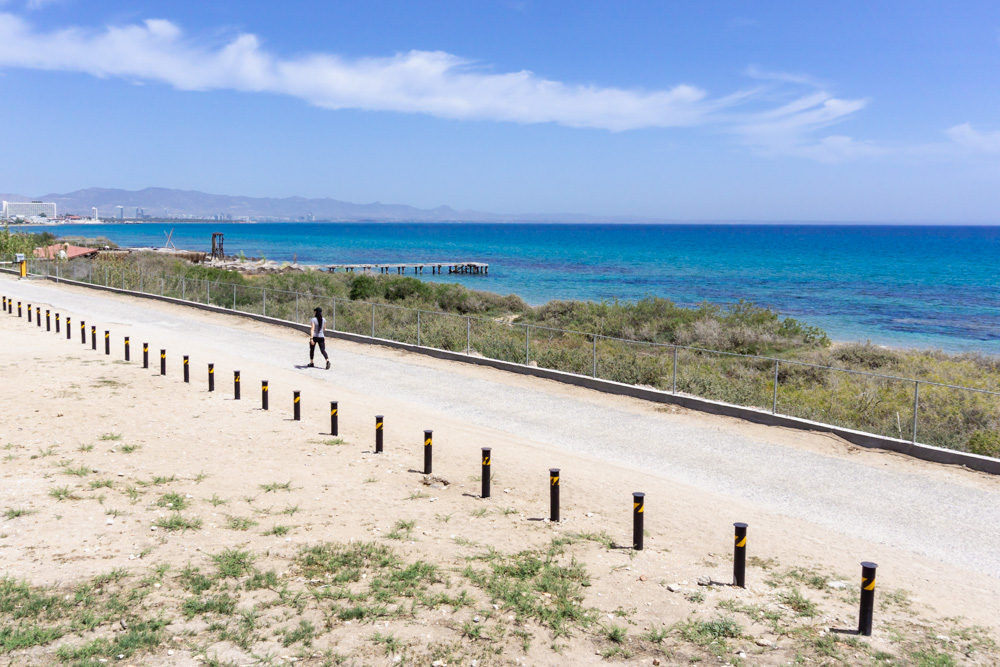
Hotels near Salamis Cyprus ruins
There are a few accommodation options close to Salamis Ruins, including places like Salamis Bay Conti Hotel, Venus Hotel, Mimoza Beach Hotel, or Salamis Park Hotel & Casino, along with some smaller camps near the coast. The whole area feels relatively quiet compared to other parts of Cyprus. As a result, it is a good choice if you’re looking to slow down a bit.
It doesn’t seem like a typical busy resort zone. Instead, it feels like a laid-back stretch by the sea. You can easily combine visiting the ruins with some time at the beach. So if you’re planning to stay longer and don’t mind a less touristy atmosphere, this area could work well.
Tips for Visiting Salamis Cyprus
If you’re visiting Salamis Ruins in summer (or even late spring and early autumn), the heat can get intense pretty quickly. There’s not much shade around, so bringing water, a cap, and proper shoes is definitely a good idea.
One thing I came across while researching (and honestly didn’t expect) is that there are snakes in the area. I didn’t see any myself, but apparently they do show up, especially closer to the more overgrown or coastal parts of the site. I even saw someone mention spotting a python near the Kampanopetra Basilica in Google reviews, which sounds a bit wild.
That said, it’s probably not something to stress about too much. Just watch where you step and avoid walking through dense vegetation. Still, it’s one of those small details that’s good to know before you go.
If you take the shorter route, you can go through the main parts of the Salamis Ruins in about an hour. But if you take your time, explore more areas, and stop for photos along the way, it can easily take two hours or longer.
Is Salamis Cyprus, Worth Visiting?
Salamis Cyprus ruins are definitely worth visiting if you don’t mind going a bit beyond the typical tourist routes on the island. Most visitors stay in southern Cyprus, so crossing into the north already feels like a slightly different experience. It does involve a checkpoint and sometimes less straightforward transport, but that’s also part of what keeps this area quieter.
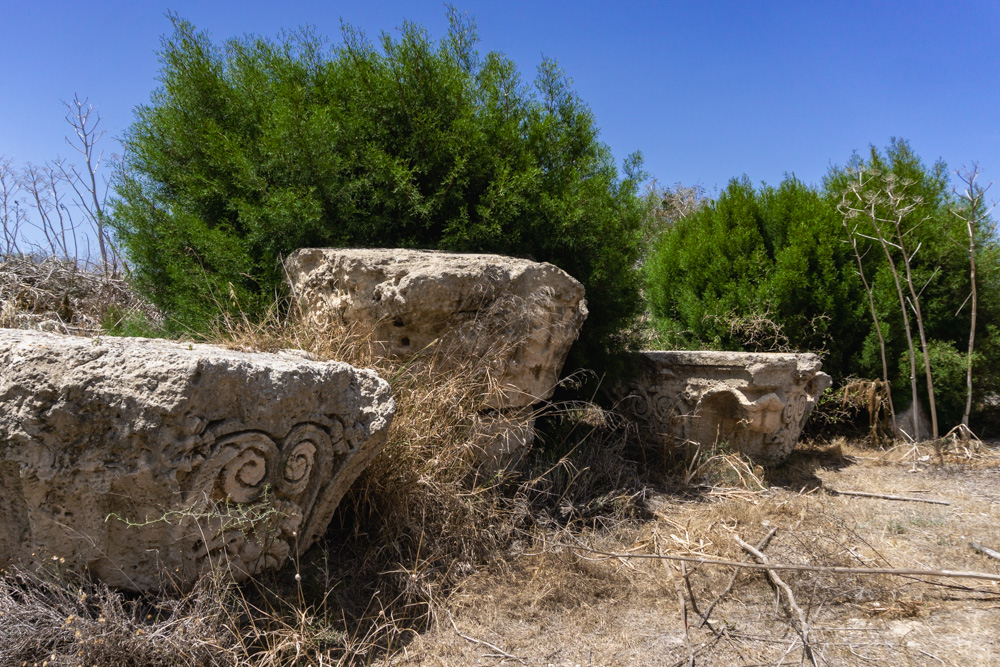
In return, you get a much more peaceful atmosphere by the sea and a different perspective on this part of the island. Compared to sites in the south, the amphitheatre here is almost as impressive as the one in Kourion. Overall, the site reminded me of Paphos Archaeological Park. It feels more overgrown and, in a way, more romantic thanks to the greenery.
Not far from Salamis, you can also visit the ruins of Gastria Castle, a lesser-known but historically interesting site. The wider region is also linked to the Knights Templar, who were active in Cyprus and left traces in nearby locations. It’s a great addition if you want to explore more than just the main ruins.
Sources:
- Cyprus Department of Antiquities – Salamis Archaeological Site
- UNFICYP (United Nations Peacekeeping Force in Cyprus) – Cyprus overview
- Encyclopaedia Britannica – Salamis (Cyprus) historical background
- TripAdvisor – Salamis Ruins visitor information
- Google Maps – Salamis Archaeological Site, Famagusta region
- UNDP Cyprus video: Salamis Ruins 3D Reconstruction (Kampanopetra Basilica)
- UNDP Cyprus video: Ancient Salamis Documentary / Site Overview
Sources: