
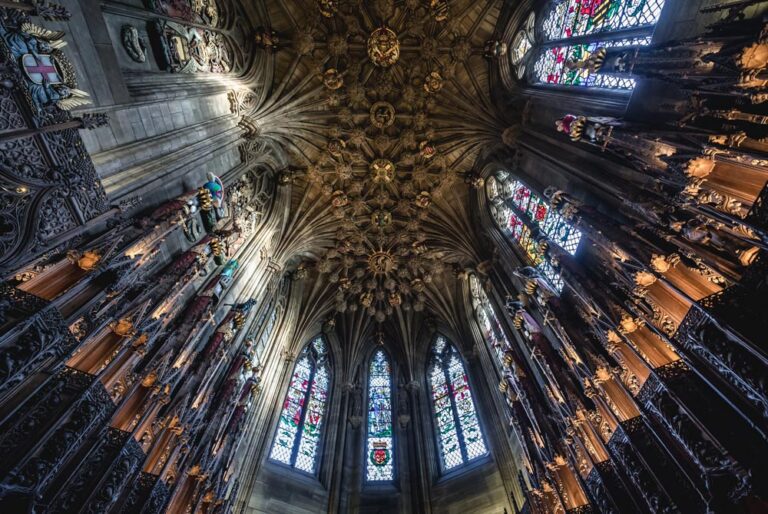
People often call Prague the City of a Hundred Spires. Its skyline features many Gothic towers and church steeples. The main Gothic jewel is the St. Vitus Cathedral in the old town. It has typical Gothic stained glass windows, a detailed façade, and a towering nave.
The famous Charles Bridge also features Prague High Gothic architecture: the Old Town Bridge Tower, built by Petr Parler. Architects also used the same style for Karlštejn Castle.
Another crucial late Gothic landmark is the Church of Our Lady before Tyn. Its twin black spires rise over the Old Town Square, creating a dark fairytale atmosphere.
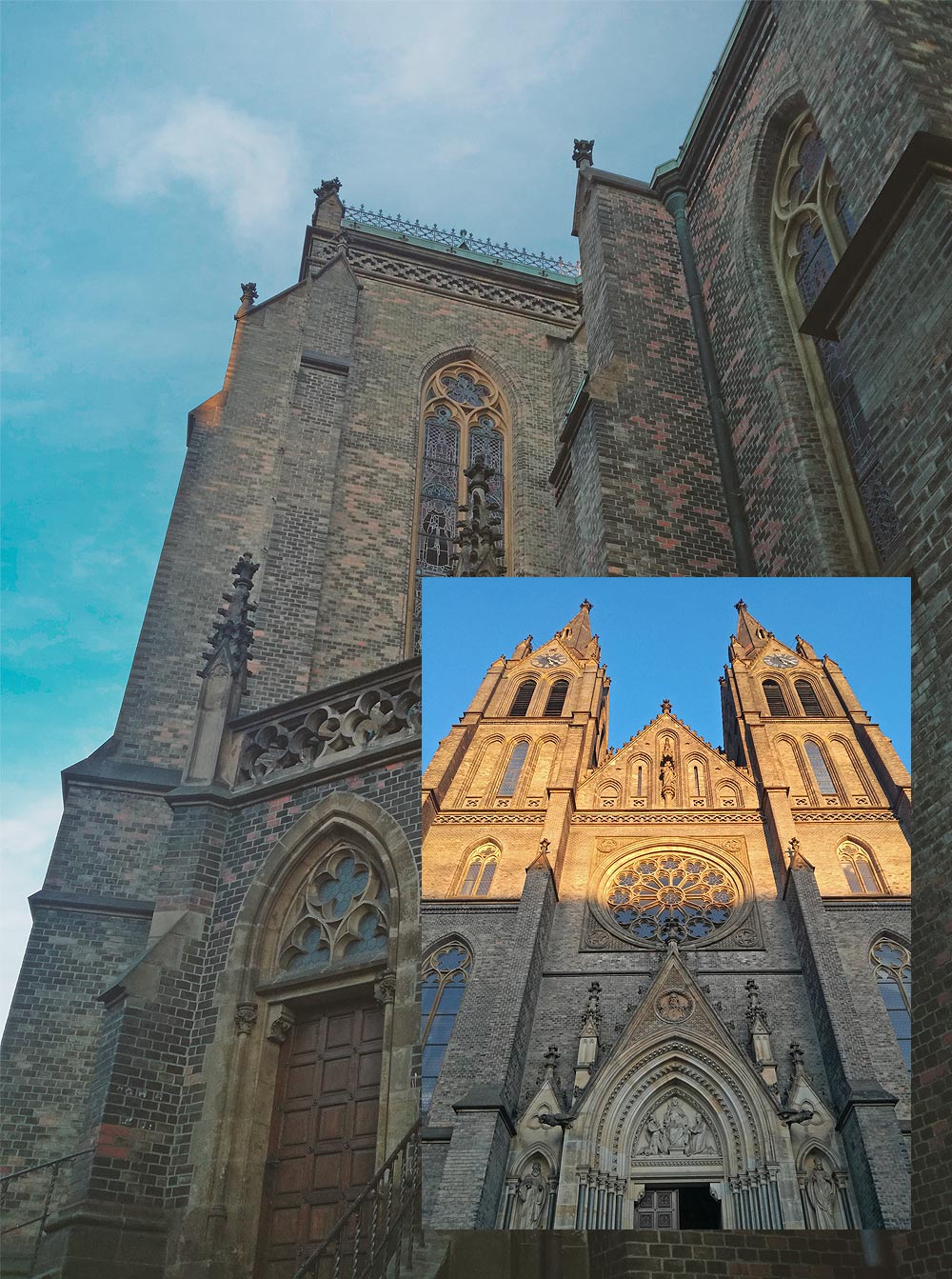
The city doesn’t come only with one or more Gothic-style buildings; the whole city has a unique Gothic character. Walking down the Old Town streets, you will find narrow streets, steep wynds, and stone façades, and it all will feel like something out of a Gothic novel. The medieval architecture produces dramatic landscapes accompanied by volcanic hills and the North Sea.
The central Gothic landmark is St. Giles’ Cathedral, with a crown-shaped spire. The stained glass and typical vaulted interior are worth checking out, especially if there is soft interior light present.
Another striking Gothic piece is the Scott Monument, a towering Victorian Gothic structure dedicated to the author Sir Walter Scott. It is the second largest monument in the world, right after the José Martí monument in Havana.
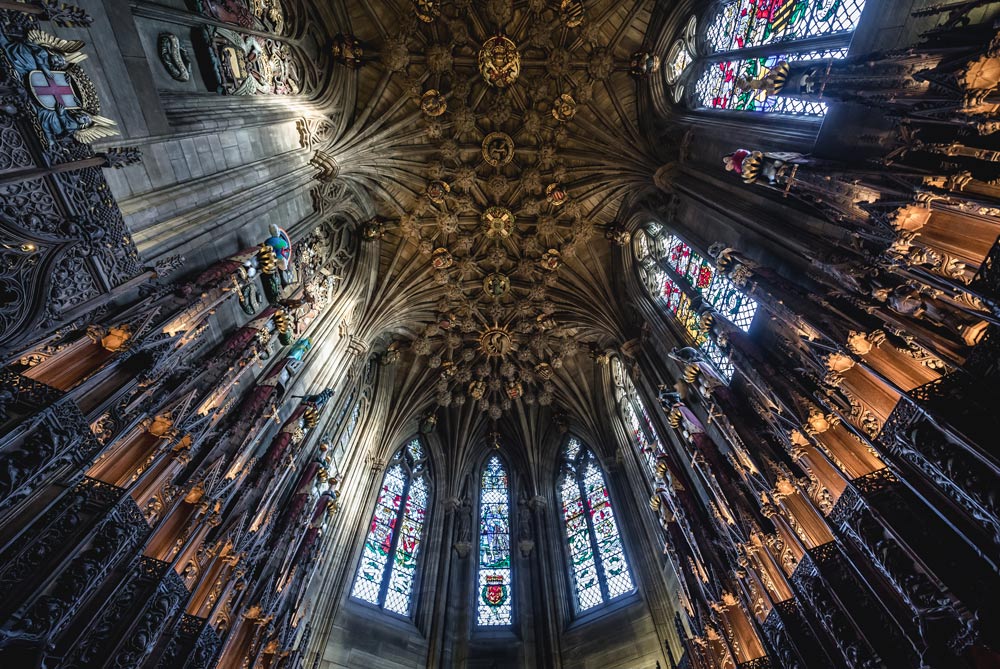
Ghent is one of the best-preserved medieval cities in Belgium. Its main gothic highlights include Saint Nicholas Church, the Belfry, and Saint Bavos Cathedral. The main dominant star is the Saint Bavos Cathedral, which is home to the world-famous Ghent Altarpiece—The Adoration of the Mystic Lamb. Its characteristic features include ribbed vaults, a soaring nave, and stained glass.
The second important Gothic structure is the Belfry of Ghent. It is a UNESCO World Heritage site, and from it, you can get stunning panoramic views of the Gothic spires scattered across Ghent.
The ideal time is to visit the town after sunset, when the mixture of guild halls, canals, and atmospheric streets glows beautifully thanks to the illuminated façades.
Brussels offers a mix of medieval heritage and a cosmopolitan backdrop. The central Gothic locations are the Cathedral of St. Michael and St. Gudula and the Town Hall on the Grand Place.
Another town with gothic charm worth visiting is Bruges. It has its canals and belfries. The main highlight is the Belfry of Bruges, which rises over the Markt square. Another dominant part of the skyline is the Church of Our Lady, which houses the Michelangelo sculpture and the Gothic tower.

Burgos is home to the biggest masterpiece of Spanish Gothic, the Cathedral of Santa María de Burgos, which is also a UNESCO World Heritage Site. You can adore its lace-like spires, rose windows, and sculpted façades. From inside, the gilded chapel, soaring vault, and choir stall can satisfy and reward all photographers who have enough time to explore the details.
Sevilla is the town with the largest Gothic cathedral in the world, the Cathedral of Seville. It is the city’s main attraction. Its ornate chapels, soaring Giralda tower, and vast nave make it a perfect subject for wide-angle photography shots.
Only a few meters away is the Royal Alcázar of Sevilla, which blends Gothic and Mudejar architecture. Mudejar art or style dates from the 13th—16th century, and its main features are ornamentation and decorations highly used in the Iberian Christian kingdoms. In architecture, the Mudejar style refers to the application of decorative Islamic art-style motifs.

Barcelona has a whole Gothic Quarter that resembles a labyrinth of medieval streets with many hidden arches, squares, and gargoyles. Although the name says it is Gothic, many of the buildings in it are not from the Middle Ages. Many of them are from the late 19th and early 20th centuries.
Throughout the years, the district has slowly transformed into a tourist attraction. Many of the Neo-Gothic buildings were built in the late 1960s.
The Barcelona Cathedral, or La Seu, is the main centerpiece of the Gothic District. It has an elaborate façade and a cloister filled with white geese. There is a tradition of having 13 white geese, which symbolize Saint Eulalia. She is the city’s patron, and a legend says that she was martyred at the age of 13. Hence, the number of the geese.
There is also the Catalan Gothic church of Santa Maria del Mar, which is often called the Cathedral of the Sea. The mixture of both styles gives the city a distinctive identity unlike other Gothic locations in Europe.

Košice, located in the eastern part of Slovakia, is home to the largest Gothic cathedral in Slovakia and the easternmost of its kind in Europe: Cathedral of St. Elizabeth. It is rich in decoration on the façade, has a soaring spire, and has many delicate details that make it the true jewel of the city’s main square.
When you look inside, there is a lot of colorful stained glass, frescoes on the walls, and the main monumental altar with two pairs of moving wings covered with Gothic paintings. If you visit the Žigmundova tower, you will step on around 160 stairs and as a result you will get super views of the city.
Another Gothic jewel in Eastern Slovakia lies closer to the border with Poland. It is also a UNESCO World Heritage town—Bardejov—a small town with a medieval square lined with colorful burgher houses. The main center of the square is the Basilica of St. Giles. The balance of Gothic architecture and the preserved urban layout creates an authentic atmosphere that is difficult to find elsewhere in Central Europe.
Just a short distance from the historic town, you can also visit Bardejov Spa, one of the oldest spa resorts in Slovakia. It adds a completely different layer to the region, combining medieval heritage with a long tradition of healing waters and wellness culture. The spa area became historically significant after Empress Sisi visited in 1895, and today it can also be explored as part of her European travel route.
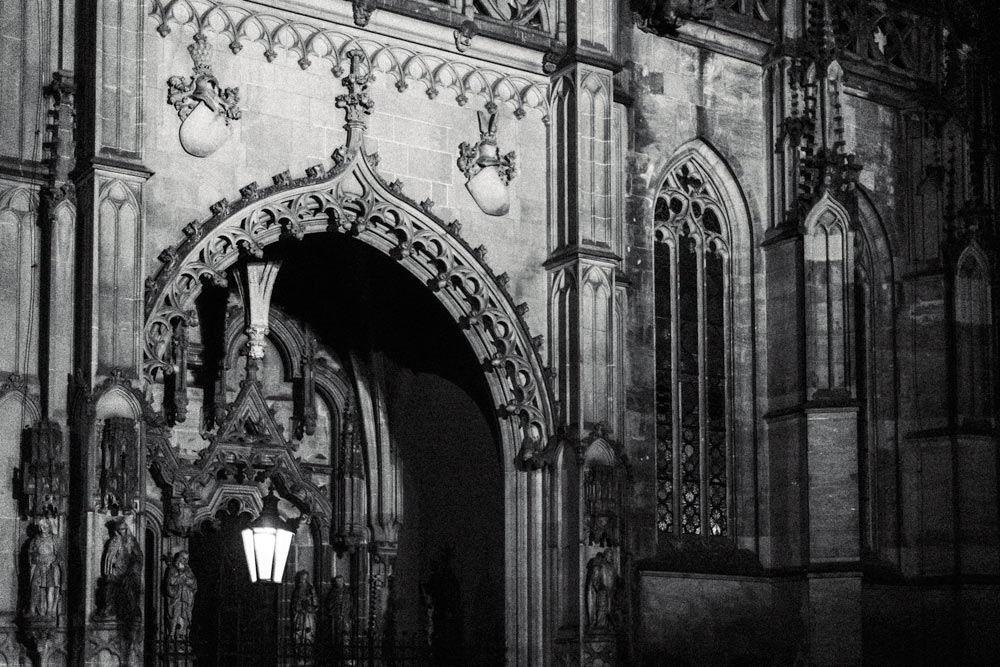

The Duomo di Milano is one of those famous buildings that does not need much introduction. This extraordinary Gothic cathedral was built over nearly six centuries. It has a white marble façade, bristles, and around 3000 statues, all wrapped up in a forest of delicate spires. You can see its majesty from afar. It totally dominates the Piazza del Duomo.
One of its highlights is the rooftop terrace, where visitors can walk among the spires and statues and enjoy intriguing panoramic views of Milan.

Rouen is a city in Normandy known for the Rouen Cathedral, a masterpiece of French Gothic. It rises dramatically over the old town, and its façade is decorated with many intricate details. The church also inspired Claude Monet in his series of cathedral paintings.
Beyond the cathedral, there are more churches, like Saint-Maclou and Saint-Quen. Each of them shows the flamboyant Gothic style. Both are rich in elaborate tracery and have many towers. The narrow streets and half-timbered houses add a more medieval backdrop.
The city is also tied to Joan of Arc’s story. Her trial and execution happened there. Many monuments, sites, and museums are connected to her legacy.
